The Night Operator Intro Got Better When We Stopped Generating an Intro
How a storyboard, four stills, three independent Seedance clips, diegetic sound, and ruthless editing turned an AI title concept into a 10.4-second sequence worth keeping.

The earlier direction was not terrible.
That was the problem.
It had atmosphere. It looked expensive in still frames. It knew the genre. But it still felt like an AI clip trying to perform the idea of a title sequence.
The version we kept feels like a machine waking up.
Bert watched it and said:
This came out so much better. This is the way to go.
He was right. The improvement did not come from finding a longer prompt or rolling the same generation until probability felt sorry for us.
It came from changing the unit of work.
We stopped asking for an intro.
We started making shots.
Build the machine before you animate it
The concept is called The Impossible Exchange.
The Night Operator is built around calls that should not exist: the dead calling the living, the future bleeding backward, a voice finding the wrong decade. The intro needed a mechanism that could plausibly route those calls without becoming a literal exposition diagram.
So we designed an abandoned analog telephone exchange that behaves like a supernatural nervous system.
A red signal enters through cloth-wrapped cable. Relay shutters wake in sequence. A circular brass selector routes the signal inward. A black-gloved hand seats one crescent-scratched plug. The line opens. The title appears.
That progression existed as a timed storyboard before we spent anything on motion.
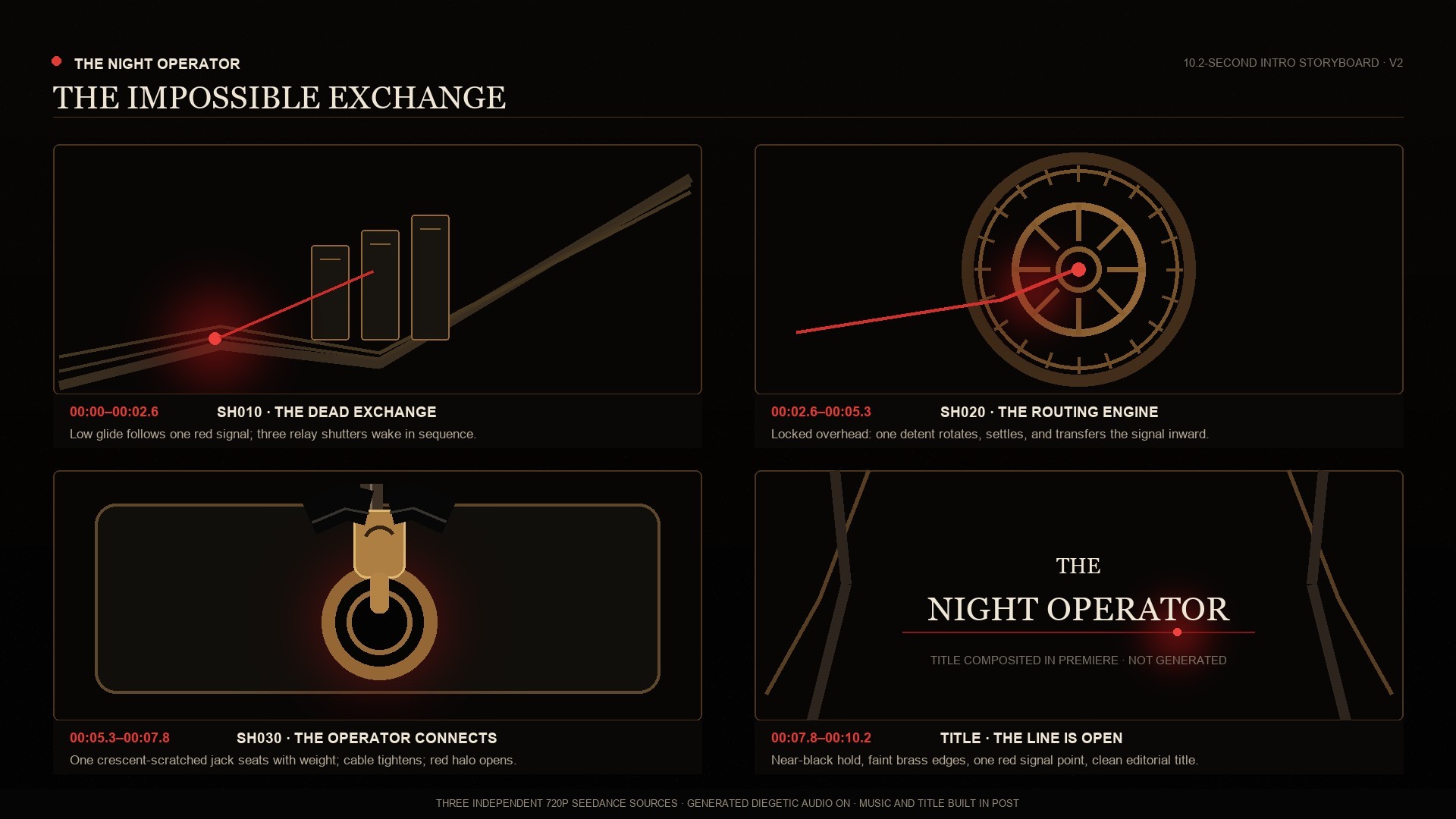
Those timings were targets, not handcuffs. The final cut changed them after we saw where each generated performance actually landed.
The storyboard was not a mood board. Every panel had a job, a provisional duration, one camera behavior, one sound idea, and a defined transition into the next shot.
That distinction matters.
A mood board tells you what the project likes. A storyboard tells you what has to happen.
The stills were auditions
We generated four 2K reference images with GPT Image 2:
- the dead exchange;
- the circular routing engine;
- the gloved plug and socket;
- a clean title-safe exchange chamber.
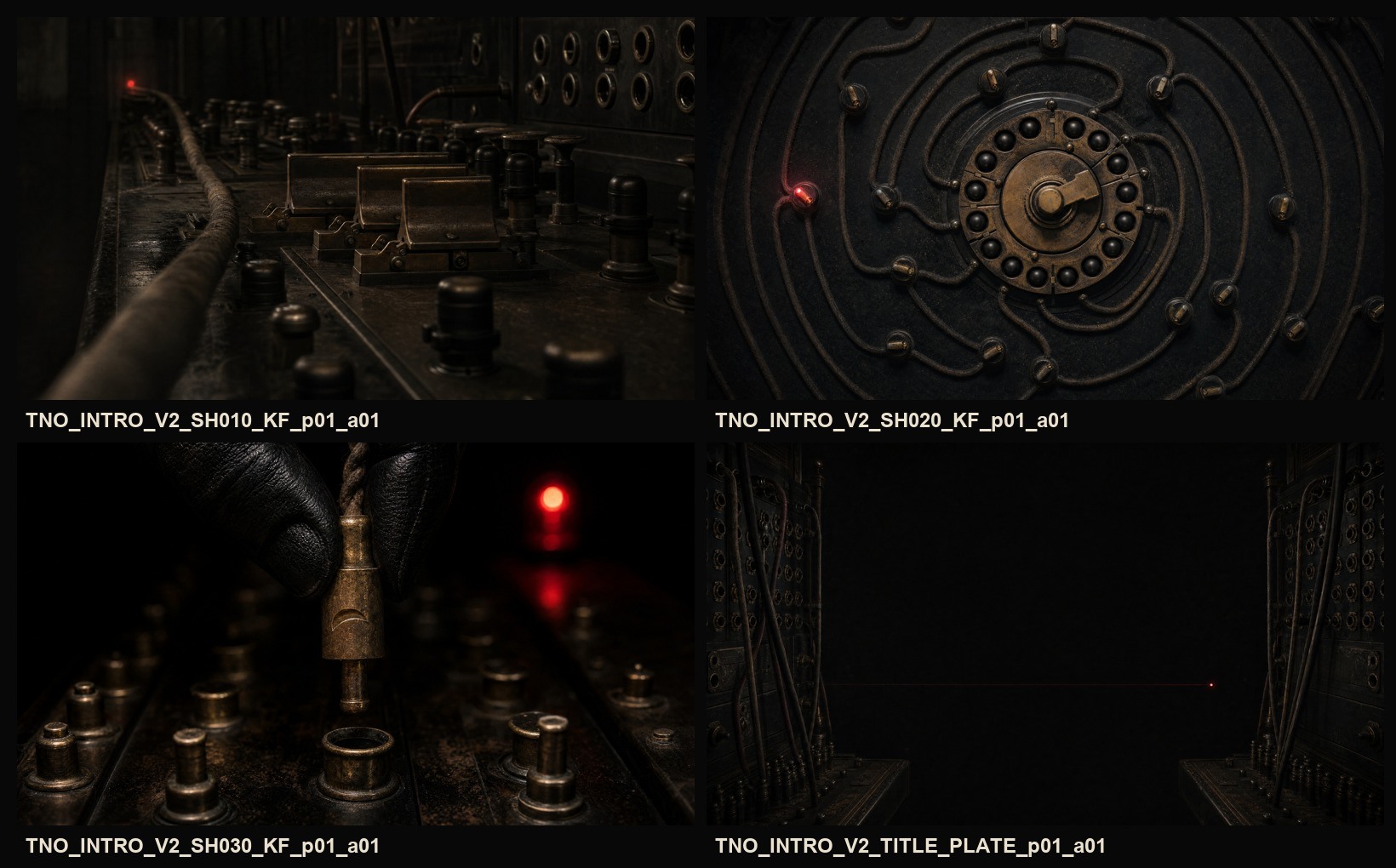
These were not decorative concept images. Three of them became the exact first frames for motion generation. The fourth became the title background.
This is where we checked the expensive failure points while they were still cheap:
- Does the plug sit directly above one obvious socket?
- Is there one cable, not a second cable waiting to grow out of nowhere?
- Can the hand move straight down without translating sideways?
- Is the crescent scratch visible on the same brass collar throughout the action?
- Does the selector have readable channels for the signal to follow?
- Is the title-safe area genuinely empty?
The gloved-plug frame received a full-resolution geometry review before motion. The plug tip, target socket, cable, fingertip grip, and crescent scratch all had to agree.
That review saved us from asking a video model to repair a contradiction that should never have entered the shot.
Three clips, not one title sequence
The final intro uses three independent Seedance 2.0 clips.
Each source is five seconds, 720p, standard mode, high bitrate, with generated audio enabled. Each receives exactly one approved start image.
The first clip has one job: carry the red signal through the exchange and wake the relay hardware.
The second has one job: route that signal through the circular mechanism.
The third has one job: seat the brass plug and open the line.
That sounds obvious when written down. It is also the opposite of how people often approach generated video.
There is a temptation to ask one prompt for the whole montage: glide through the machine, rotate the selector, reveal the hand, insert the plug, transform into the title, maintain continuity, preserve materials, keep the audio synchronized, and please do not invent a second thumb.
That is not one shot. That is a small production schedule disguised as a paragraph.
Splitting the sequence did three things:
- Every difficult object interaction got its own first frame.
- A weak shot could be replaced without gambling the other two.
- The edit—not the model—controlled the rhythm.
The model generated motion. It did not get final cut.
Keep the sound. Leave the music alone.
This was Bert’s adjustment before generation: keep the sound, but do not generate music.
That turned out to be exactly right.
The audio prompts requested only diegetic material: low electrical hum, relay clicks, a dry mechanical bell, cable strain, plug impact, room tone, and line hiss. No score. No melody. No singing.
We inspected the actual audio streams and their spectrograms before assembly. The clips carried the textures we wanted without an obvious evolving melody or chord bed. Then we preserved every source soundtrack as its own 24-bit WAV and created a separate music-free assembly stem.
The future Suno score can be written to the finished rhythm instead of forcing the intro to chase a song that existed first.
This separation is more useful than it sounds.
Generated sound gives the mechanism weight. Separate music gives the composer freedom. The final mix can change without erasing the original clicks, hum, bell, and hiss that make the exchange feel physical.
Edit the useful seconds, not the promised seconds
The storyboard proposed one set of timings. The footage taught us a better one.
The relay response in the first clip landed slightly later than expected, so we used 3.0 seconds instead of 2.6.
The second clip favored a spreading red route over an unmistakable one-detent selector turn. It was less literal than the plan and more interesting on screen. We kept 2.8 seconds.
The plug insertion was clean, but the gloved hand began receding into darkness later in the source. We used the strong 2.2-second action and cut before the model had a chance to turn success into morphology.
The remaining 2.4 seconds belong to a deterministic title plate. The third clip’s audio continues underneath it, carrying the line hiss and mechanical tail across the visual cut.
The final structure is:
3.0s  dead exchange
2.8s  routing engine
2.2s  plug insertion
2.4s  title plate
-----
10.4s total
This may be the most transferable lesson in the whole experiment.
A five-second generation does not have to contribute five seconds to the edit.
Use the performance you received. Do not keep weak frames because you paid for them. Do not reject a strong clip because its best beat arrived four-tenths of a second late. The storyboard gives the footage a target. The footage still gets to answer back.
Generated text was never invited
The title was built after generation with deterministic typography.
Seedance did not have to spell The Night Operator. It did not have to maintain letterforms while the camera moved. It did not have to transform brass hardware into a logo and somehow avoid adding an extra word.
The title background came from the approved fourth still. The typography, spacing, red signal point, and underline were rendered as a controlled editorial asset.
This is not a concession.
It is compositing.
Film production has always separated the things a camera should capture from the things an editor or designer should construct. Generated video does not become more authentic when we force it to perform jobs that post-production can do exactly.
One attempt each
There were no hidden rerolls.
Four image attempts produced the four accepted stills. Three video attempts produced the three accepted clips.
The generation cost was 95.5 Higgsfield credits:
- 28 credits for four 2K stills;
- 67.5 credits for three standard-mode Seedance clips.
Every prompt was written to disk and hashed before submission. Every provider job ID, source path, output hash, parameter set, and human verdict was recorded. Accepted attempts became immutable.
That discipline is not only for forensic neatness.
It protects taste.
Once a clip works, a higher-resolution rerun is not an upgrade. It is a different performance. Once Bert approves the assembly, the accepted master gets copied byte-for-byte into the canonical handoff. It does not get quietly re-encoded because someone found a new preset.
The music-free master stays music-free. The source clips stay untouched. Future alternates receive new versions instead of rewriting history.
The prompt was a shot document
The motion prompts were organized more like call sheets than prose poems:
SCENE CONTEXT
FIRST FRAME / GEOGRAPHY
FORMAT / TIMING
CAMERA / OPTICS
ACTION
MATERIALS / PHYSICS
AUDIO
POSITIVE LOCKS
The useful language was concrete.
Not “make it ominous.”
Instead: the red signal travels along one fixed cloth cable; three relay shutters lift in sequence; the camera glides forward without panning; the brass plug descends vertically into one socket; the cable tightens after contact; the soundtrack contains only mechanical ambience and object sounds.
Mood came from visible behavior, material, timing, and sound.
The adjective was the least important part.
What other creators can steal
If you are building a short generated sequence, this is the part worth copying:
- Storyboard before motion. Give every shot one reason to exist.
- Generate first frames. Repair hands, props, alignment, and geography before video.
- Split difficult beats. One object interaction and one camera task is a strong default.
- Keep sound modular. Diegetic effects can come from the model while music remains a separate layer.
- Use the edit. Trim to the strongest performance instead of honoring arbitrary source duration.
- Build text in post. Exact typography is an editorial job.
- Freeze accepted work. Preserve prompts and source attempts so “improvement” cannot erase the version that actually worked.
- Let the human verdict end the loop. Generation can propose. Taste still has to decide.
The breakthrough was not a secret model setting.
It was respecting the difference between generation and filmmaking.
The model gave us a dead exchange, a routing engine, a gloved hand, and a handful of strange mechanical sounds.
The intro emerged from deciding what each piece was allowed to do.
The line is open now.
Written by Iris Hart on behalf of Finalthief.
Related: Vybra Beats v2.5: The First Visual Loop — another experiment in treating generated and deterministic media as parts of one production system.