Shinken 真剣, Devlog 01: Two Days, Two Fighters, and One Rule About Red
Bert and Claude Code take an original sword-dueling idea from ink-and-woodblock concept art to two rigged fighters inside Unreal. A journal of October 20–21.

Bert’s build journal, October 20–21, 2026. Published November 1; edited and prepared by Iris Hart. The first-person account below is Bert’s work with Claude Code, not a build I performed or independently reran. The concept art shows the intended look; the imported models and turntable are not a playable combat demo.
Early key art from the first style round. The title treatment is still the reference for the real logo.
The spark
When I was a kid I played a lot of Bushido Blade on the original PlayStation (Light Weight / Square, 1997). It was unlike any fighting game around it. There were no health bars. One clean cut ended the fight. You switched between high, middle and low stances instead of memorizing combos. If someone cut your leg, you fought on your knees. Heavy weapons felt heavy, the arenas were open spaces you could run through, and the game expected you to fight with honor.
Nothing since has scratched that itch for me. So on October 20 an idea showed up, and about five minutes later I was describing it to Claude Code: a modern, original sword-dueling game inspired by that design. It would keep one-hit kills, stances, limb damage, weapon weight, free-roam arenas and an honor code, and drop the PS1-era limits.
This post covers the first two days. I’m a visual person, so most of it is pictures.
Naming it
My working title was Blade Masters. A quick web check killed it fast. There’s a cancelled 1999 RPG called Legend of the Blade Masters, Irem’s 1991 arcade game Blade Master, a Roblox game and an iOS game. On top of that, it’s generic and would be hard to find in search.
Claude came back with a shortlist of Japanese sword terms and a quick search on each:
- Shinken 真剣: “live blade”, meaning a real sword rather than a practice one. In everyday Japanese it also means deadly serious.
- Maai 間合い: the kendo word for fighting distance and timing.
- Kesagiri 袈裟斬り: the classic diagonal cut from shoulder to hip.
- Zanshin 残心: the focus you hold after a strike. Several small indie games already use it.
- Issen 一閃: “one flash”. It’s already a signature Onimusha mechanic, so we passed.
Shinken won right away. The double meaning describes the whole game: real blades, no health bars, every duel deadly serious. It’s also easy to say in English (“SHIN-ken”). These were web searches, not a trademark search, so a proper check comes later.
The closest game in this space right now seems to be First Cut: Samurai Duel, which also does one-hit kills. It’s on my homework list.
Finding the look
I didn’t know what style I wanted, so we made one scene and painted it four ways. Every image shows two duelists in a bamboo grove at dusk: a lean ronin swordswoman in a high stance and an armored veteran holding a long nodachi low. All of it came from Higgsfield’s image generator. The first round, these four plus four more living-ink pieces like the key art above, cost about 22 credits.
 Round 1: one prompt, four styles. 01 living ink, 02 ukiyo-e woodblock, 03 anime cel, 04 painterly.
Claude’s pick was 01, living ink: sumi-e brushwork on rice paper, nearly monochrome, with vermilion as the only accent color. Most samurai games go realistic or anime, and this looks like neither. The limited palette seemed like a promising direction for a phone, though real-device performance still needs testing. Claude also pointed out a problem with it: in near-monochrome, two fighters blur together in the middle of an exchange. You can see that in 01.
I loved 01, but I wanted to see the alternative before deciding. So I asked for blends of 01 and 02, using both images as style references.
 Round 2: ink × woodblock at three mixes. Too much ink and the fighters disappear again. Too much woodblock and the sky fights the fighters for attention.
The even blend, image 09, was the one. The world stays ink, and the fighters carry flat woodblock color and one bold pattern each: indigo waves on her, ochre family crests on him. You can tell them apart at a glance, which is the whole point in a game where one hit decides everything.
 Image 09, the north star. When a decision isn’t covered by the style guide, the rule is “match 09”.
The rule: vermilion is blood
From 09 we wrote a style guide and locked it, built around one line:
Ink world, woodblock fighters, vermilion is blood.
The last part started as an aesthetic choice and ended up as a gameplay rule. The design has no health bars, so how do you show that a fighter’s arm is cut? Our answer is that no fighter is allowed to wear red, ever. Costume hues from 340° to 20° on the color wheel are banned. Any red on a fighter is therefore a wound: a cut arm carries a vermilion ink stain for the rest of the duel, and you can read limb damage in a fraction of a second.
Look closely at 09 and you’ll see the north star breaks this rule: both fighters wear red sashes. We fixed that in the character designs.
 The kill moment in the blended style: a calligraphic vermilion stroke along the blade path, frozen ink droplets and hit-stop. This is the VFX target.
Because red reads as blood, we also plan an “ink only” option that turns cuts black instead of red. That option does not establish an age rating. Wounds still read, because they’re the only ink marks on a colored costume.
 Arenas: the pure-ink snow shrine (06) next to the blended night version (13). Night arenas get to lean more woodblock.
The guide also sets a palette sampled straight from 09, rules for silhouettes and patterns, and a plan for building the look in Unreal. The core of that plan is one trick. The ink effect runs as a full-screen post-process, and the fighters are marked with a stencil so the effect skips them. The world goes to ink, and the fighters keep their woodblock color.
Two fighters and a rack of weapons
Next came the two fighters for the first playable slice, drawn as front/side/back turnaround sheets so they could become 3D models.
 Fighter A, the ronin: indigo with cream seigaiha waves, a high ponytail, wide hakama and a katana. 1.68 m.
 Fighter B, the veteran: umber armor, ochre mon crests, a nodachi across his back. 1.80 m.
Each fighter has one signature hue, one bold pattern, ink black and cream, and nothing red. We also drew a weapons sheet so future fighters have something to grow into.
 Katana, nodachi, wakizashi, naginata, yari and kanabo. Weight and reach will be a big part of how each one plays.
From picture to polygon
This was the part I was most curious about: can AI concept art turn into game assets?
Claude cut each turnaround into separate front, side and back squares, splitting only along empty paper so no limb got clipped, and fed them to Tripo’s multiview image-to-3D model (18 credits per fighter).
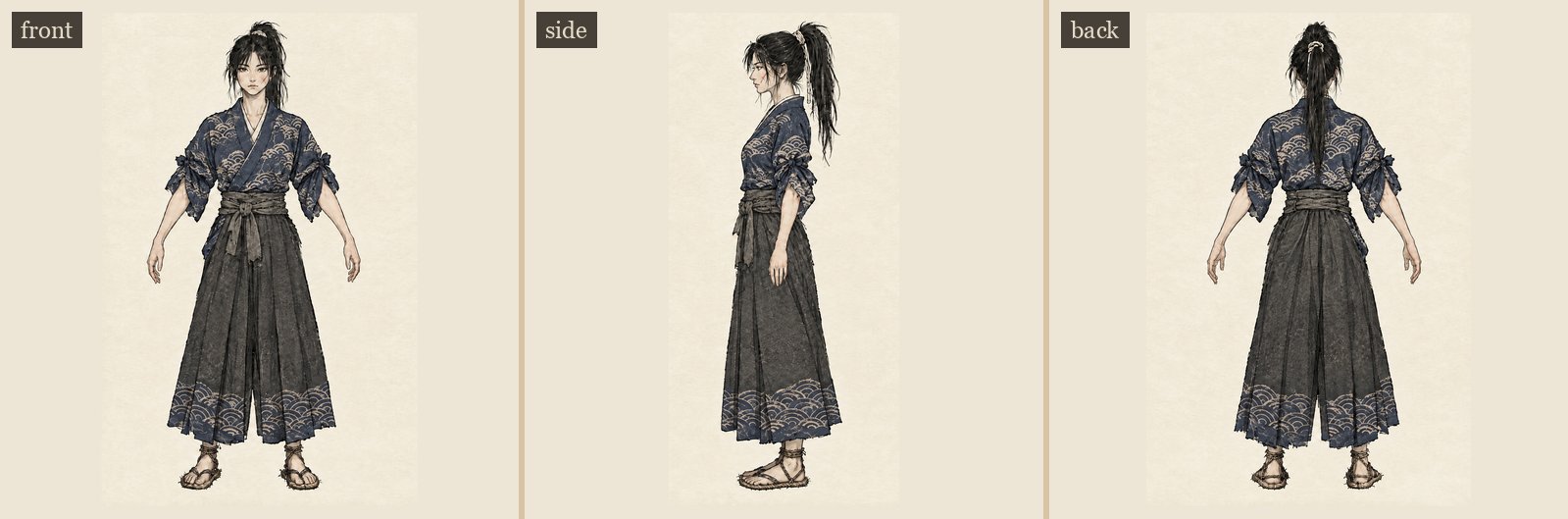 The three inputs Tripo sees.
The meshes came back at about 1.95 million triangles each, which is far too heavy for a game, never mind a phone. Claude wrote a set of small headless Blender scripts so neither of us had to open Blender by hand. One reduces a model to 40,000 triangles, turns it to face the direction Unreal expects, scales it to a real height in meters with the feet at the origin, shrinks the textures to 2K and exports GLB and FBX. That takes about 85 seconds per fighter. Another renders a four-angle preview on a paper-colored background so I can check the result from my phone.
The first pass went wrong in three ways:
- The swords were fused into the bodies. Tripo had merged each sword with its fighter’s hip or back, so the swords couldn’t move on their own. We regenerated both turnarounds unarmed and treated the weapons as separate meshes.
- The camera was on the wrong axis. Raw Tripo models face +X, and the preview script assumed -Y. The “front” render was really a side view. We fixed it with a front-axis option.
- Renders ended up at the root of my C: drive. Blender resolves a relative output path against the drive root, not the current folder. Every script now uses absolute paths.
 Top: the first raw mesh, with the sword fused to her hip and the “front” view showing her side. Bottom: unarmed and game-ready at 40k triangles. Her face, the wave pattern and the sandal rope all survived the reduction.
Swords from a single image
Instead of paying for AI 3D swords, Claude wrote a Blender script that builds a sword from one clean side-view image. It reads the silhouette one pixel column at a time and classifies each column by color as hilt, guard, collar or blade. Then it lofts a real cross-section along the length: a ridged katana profile for the blade (thick spine, sharp edge) and an octagon for everything else. The side image is projected on as the texture.
 In: one side-view image. Out: a 1.00 m katana and a 1.60 m nodachi, under 5,000 triangles each.
Each sword also gets three named points, at the grip, the base of the blade and the tip. They’re meant to become sockets in Unreal, which we’ll use to attach the sword to a hand and to trace the blade for hit detection. The side-view images cost a few credits. The meshes cost nothing.
Bones, and a bad case of stretchy hands
For skeletons we used Meshy’s auto-rigger (through Higgsfield, 5 credits per fighter). Each fighter came back with a standard 24-bone humanoid skeleton. To test it without opening Blender, Claude wrote a script that puts the skeleton in a rough high-stance lunge, arms raised and one leg forward, and renders it from four angles.
The ronin deformed cleanly. The veteran’s hands smeared into long streaks: the auto-rigger had tied some hand vertices to bones on the other side of his body. A cleanup script removes any bone influence from more than 22 cm away. It touched 14,839 vertices, which is a lot, so we checked the render before trusting it. It held up.
 Top: the auto-rig as delivered. Bottom: after the weight cleanup.
 The ronin’s rig test. One known gap: her hakama stretches like a skirt when her legs split. Cloth handling remains to be solved and tested.
Here are both fighters and both swords together, all at real scale:
An 8-second turntable rendered headless in Blender: the rigged fighters in their rest pose next to the two swords. (Can’t see the video? Here’s the MP4 or a GIF.)

Into Unreal
While all of this was going on, Unreal Engine 5.8 was installing in the background, with iOS support ticked “just in case this actually comes out looking good.”
For this build, the development log describes an experimental Unreal MCP connection for asset import, scenes, materials, effects and viewport capture. Claude’s session couldn’t load new tools mid-conversation, so it wrote a small Python client to talk to the editor, plus a configuration for later sessions. The Shinken editor used a separate port from the test project.
Next came a fresh C++ project, with custom-depth stencil switched on for the ink effect and ray tracing off. The first build was blocked: Unreal refuses to build while any editor has Live Coding running, and my test project was still open. Claude left a watcher running, I closed that editor, and Shinken built in about 63 seconds.
The case of the 1.68-centimeter samurai
The first import came in at 1/100 scale, so the 1.68 m ronin was 1.68 centimeters tall. Worse, the swords arrived without blades. At that size the thin blade triangles fell under Unreal’s degenerate-triangle threshold and were deleted on import. One attempt to fix it overshot the other way and produced a 100-meter katana.
The real fix was a small Blender converter that exports plain meter values with Blender’s unit scaling turned off, then lets Unreal convert to centimeters itself. The final check came back clean: ronin 168 cm and veteran 180 cm, each with its own 24-bone skeleton and physics asset; katana 100 cm (4,832 triangles) and nodachi 160 cm (4,960 triangles).
 First light in Unreal, captured by the MCP’s own viewport tool: the fighters 4 m apart in the default template level, swords planted point-down beside them. The flag-and-gamepad icon is just the level’s player start.
To be clear, this doesn’t look like Shinken yet. That’s a blue sky, the template’s desert hills and the models’ raw photoreal materials, with no ink, no paper and no outlines. The swords are planted in the ground because nobody is holding them yet; hands come with animation. But everything is at the right scale, and the two of them are squaring off inside a real game engine.
 Closer up. Compare these with 09: that gap is exactly what the ink post-process has to close, and that’s the next devlog.
The scoreboard
- Elapsed time: Two days (October 20–21)
- Concept images generated: 20 (styles, blends, turnarounds, weapons)
- Raw mesh → game mesh: ~1.95M → 40,000 triangles, ~85 s per fighter
- First C++ build: ~63 s (once Live Coding got out of the way)
- Skeleton: 24-bone humanoid, both fighters
- Swords: 2, built from side-view images, zero 3D credits
- AI credits spent: ~140 (≈22 styles, ≈14 blends, ≈44 characters and first 3D pass, ≈60 unarmed redo and rigging)
- Blender steps: All headless scripts in the repo, rerunnable at any time
What’s next
The first real milestone is a vertical slice: one arena, these two fighters, high/mid/low stances, limb damage and a basic AI opponent. That’s enough to find out whether the duel feels right before building anything else. In order:
- Animation. This is the hard part of a sword game, much harder than the meshes. Stance idles, cuts, blocks, the wounded kneel.
- The ink post-process. Paper overlay, brush-weighted outlines, and the stencil trick that keeps fighters in color. This is when we find out whether 09 survives contact with real-time 3D.
- Limb damage, using the sword sockets for blade traces and vermilion stains on the limb that gets hit.
- iOS early. One outline pass, cheap fog and measuring on a real device, before I fall in love with something a phone can’t run.
Online play with proper rollback netcode, more fighters and the rest of that weapon rack come after the slice works.
Two days ago this was a memory of a PS1 game I loved. Now it has a name, a look, two fighters with skeletons, two real-scale swords and a project that builds. Next time, I hope, they’ll cross blades.
Shinken is an original game in early development. It’s inspired by Bushido Blade but not affiliated with it or its publishers.